
If you are running a small business and trying to figure out where to put your advertising money in 2026, there is a very good chance you have already lost sleep over this exact question. The debate around Facebook ads vs Google ads 2026 is louder than ever, and for good reason both platforms have changed significantly, costs have shifted, and the rules of what works have been rewritten. Small businesses especially need to think carefully here, because unlike large corporations with sprawling marketing departments and unlimited testing budgets, you are working with real constraints. The wrong platform can drain your cash in weeks. The right one can completely transform your revenue. So let us get into this properly, because small businesses deserve a real answer not a vague “it depends” that leaves you more confused than when you started.
Within the first hundred words of this conversation, it is worth saying clearly: small businesses in 2026 are not short of advertising options. The challenge is not access it is clarity. And that clarity starts with understanding what each platform actually does, how it charges you, and which one aligns with the way your customers actually make buying decisions.
Understanding What Has Actually Changed in 2026 and Why Small Businesses Should Pay Attention
The advertising landscape in 2026 is meaningfully different from even two or three years ago. Meta has rebuilt a significant portion of its advertising infrastructure after years of battling privacy changes triggered by Apple’s iOS updates. Their AI-based targeting system now called Advantage+ has become remarkably good at finding the right audiences even with less third-party data, because Meta has leaned heavily into on-platform behavioral signals and their own first-party data ecosystem. This is genuinely good news for anyone asking which is better Facebook ads or Google ads for small business, because it means Facebook has closed a lot of the performance gap that opened up after the iOS 14 changes.
Google, on the other hand, has pushed Performance Max campaigns into the mainstream, and in 2026 this is now the default campaign type Google encourages most advertisers to use. Performance Max combines search, display, YouTube, Gmail, and Google Maps all into one campaign driven by machine learning. Google has also introduced more AI-generated ad copy suggestions, automated bidding strategies, and smarter predictive audience tools. For small businesses, the practical effect of all this AI investment is that both platforms are more beginner-friendly than they have ever been but creative quality has become the single most important factor separating campaigns that generate genuine returns from campaigns that quietly burn through budgets.
How Google Ads Works and Why Intent Is the Single Biggest Advantage It Offers
Google Ads is fundamentally built on the concept of intent. When someone types “emergency plumber in Leeds” or “best accountant for small business near me” into Google, they are not browsing. They are not killing time. They are looking for a solution right now and they are ready to act. This is the core reason the Google ads vs Facebook ads for local business debate so often tilts toward Google for service-based companies because no other platform on earth captures that moment of active searching the way Google does.
For small businesses in local service industries like law firms, dental clinics, plumbing companies, tutoring services, financial advisors, and repair shops, Google Search Ads remain one of the most powerful tools available. The Google ads cost per click 2026 small business figures vary significantly by industry in competitive sectors like legal or financial services in the UK, you might pay anywhere from £8 to £40 per click, while in less competitive local niches like fitness studios or boutique retail, clicks can be as affordable as £0.50 to £2.50. This wide range is exactly why any conversation about Google Ads budgets must start with keyword research before a single penny is committed.
The question of Google ads worth it for small business almost always comes back to this: if your customers are actively searching for what you sell, then yes Google Ads is absolutely worth it, because you are meeting them at precisely the right moment. If your customers do not yet know your product or service exists, that is a different story, and that is where Facebook enters the picture.
How Facebook Ads Works and Why Discovery Changes the Entire Conversation
Facebook Ads operates on an entirely different psychological premise. Nobody opens Facebook or Instagram to search for a plumber. They open it to scroll, to see what friends are doing, to watch videos, and to exist in a social environment. Facebook Ads inserts your message into that experience which means you are not capturing existing demand, you are creating new demand. You are putting your product or service in front of people who were not actively looking for it, but who match the behavioral and demographic profile of someone who would genuinely benefit from it.
This is where Facebook’s real power lies, and in 2026 that power has grown considerably. The Facebook ads ROI small business 2026 picture looks significantly better than it did in 2022 or 2023, largely because Meta’s Advantage+ system has gotten remarkably good at identifying likely buyers without requiring advertisers to manually build complex audience segments. If you have a pixel installed on your website and even a basic customer email list, Meta can build lookalike audiences that are shockingly accurate.
The Facebook ads cost per lead 2026 varies considerably by industry and by how well your funnel is set up. For consumer-facing businesses with visually compelling products think handmade jewelry, artisan food, fashion, home décor, fitness products Facebook can deliver leads and sales at a lower cost than Google simply because the visual format suits the product, and the audience discovery mechanism is more efficient at the awareness stage. Facebook ads worth it 2026 is a question that gets a confident yes for any business that has a strong visual story to tell, a clearly defined target customer profile, and a product or service that benefits from being discovered rather than searched.
The ROI Comparison That Small Business Owners Need to See Honestly
When people ask about ROI comparison paid advertising 2026, the honest answer is that return on investment is almost entirely dependent on three things your business type, your creative quality, and your average customer value. There is no universal winner, but there are clear patterns worth knowing.
For businesses with high-ticket services and longer sales cycles think B2B consultancy, legal services, financial planning, or specialist medical practices Google Ads typically delivers better ROI because you are reaching people who are already in buying mode. The conversion journey is shorter, lead quality is higher, and the cost per actual customer acquisition is often lower even when the cost per click is higher. A Google Search campaign spending £1,500 per month and generating 12 qualified leads for a solicitor’s firm is almost certainly more valuable than a Facebook campaign spending the same amount and generating 60 low-intent enquiries.
For businesses selling visual, lifestyle-driven, or impulse-purchase products handmade goods, fashion accessories, subscription boxes, online courses, beauty products Facebook often delivers dramatically better ROI because the platform format suits the product, and cost per acquisition can be kept very low with strong creative. The paid ads comparison 2026 for these categories consistently shows Facebook outperforming Google at the awareness and consideration stages.
For local businesses restaurants, boutique gyms, salons, florists, retail shops a combination almost always outperforms either platform alone. Google captures people who are actively searching, and Facebook builds brand familiarity for people in your local area who are not searching yet but might be very soon.
Google Ads vs Facebook Ads Cost Comparison: What the Numbers Actually Look Like
The Google ads vs Facebook ads cost comparison question deserves a careful answer because raw costs are misleading without context. On Facebook in 2026, cost per thousand impressions in the UK typically range from £8 to £20 depending on your audience and placement. Cost per click for many consumer niches sits between £0.30 and £1.50. These numbers look attractive on paper but because Facebook traffic is not high-intent, your cost per actual conversion can be higher than expected if your landing page and offer are not optimized.
On Google Search Ads, cost per click is higher anywhere from £1.50 to £40 depending on your niche but conversion rates are significantly higher too, because you are reaching people who are actively shopping. This is why the small business advertising budget Facebook vs Google conversation is really about cost per acquisition rather than cost per click. Run the numbers based on what a new customer is actually worth to your business, and you will quickly see which platform gives you more room to operate profitably.
The Facebook ads vs search ads which is cheaper debate is best settled by testing. Put £300 on each platform for 30 days, use a simple lead generation goal, and measure cost per enquiry. That data will tell you more than any industry benchmark ever could, because your specific offer, your creative, and your local market all influence the outcome more than platform-level averages do.
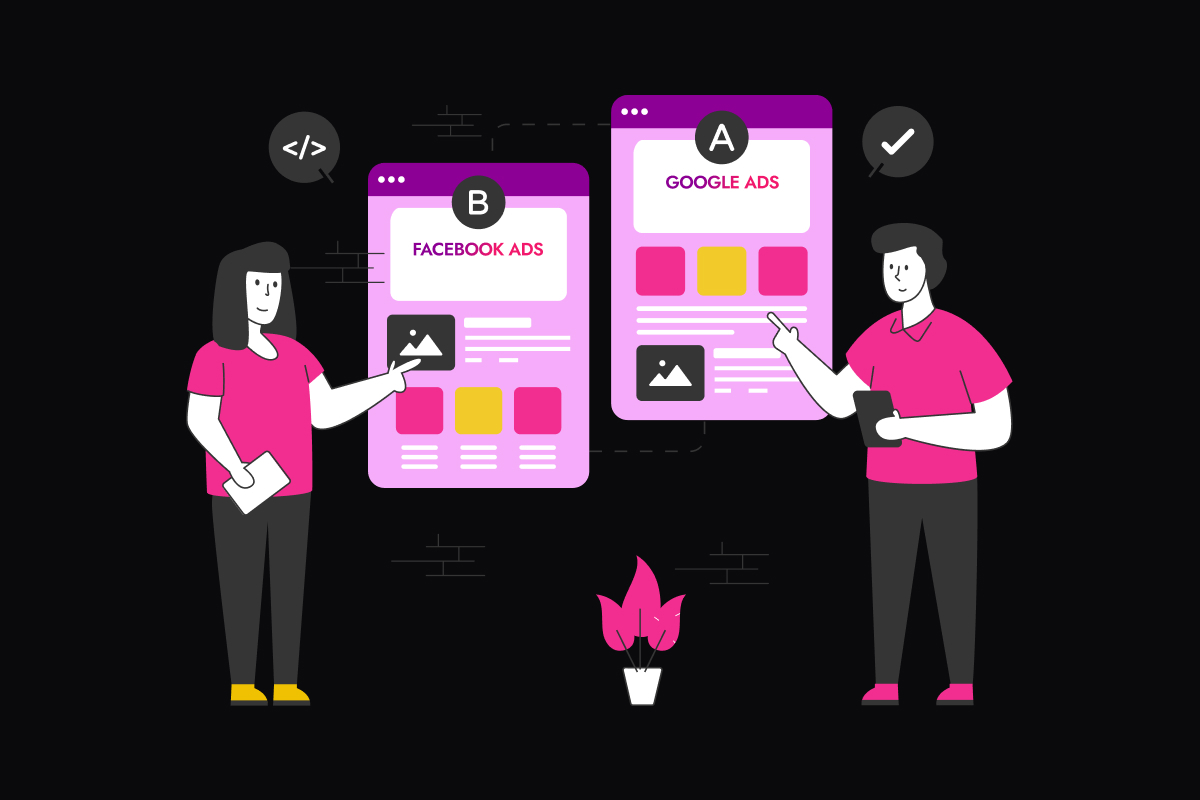
When to Use Google Ads and When Facebook Makes More Strategic Sense
The guidance on when to use Google ads vs Facebook ads is clearer than most people expect once you apply it to specific scenarios. If your customers search for your service category by name “dentist near me,” “accountant for freelancers,” “leak detection service Manchester” then Google Search Ads should almost always be your first investment. You want to be visible at that exact moment of intent, and nothing replicates that moment like Google.
Facebook makes more strategic sense when your product needs to be seen to be appreciated, when your audience does not yet know your product category exists, when you are launching a new brand and need to build awareness fast, or when you have strong visual content short videos, before-and-after images, lifestyle photography that tells your brand story in a compelling way. Facebook is also significantly better for retargeting, and in 2026 Meta’s retargeting capabilities have become even more sophisticated.
For the question of Google ads or Facebook ads for service business, the answer in most cases is Google first and Facebook second. Use Google to find customers who are actively searching for what you offer. Use Facebook to stay visible to warm audiences past website visitors, past customers, and people in your local area who have engaged with your content so that when they are ready to buy, your name is the first one they think of.
The Best PPC Platform for Small Business in 2026: What the Data Is Actually Showing
The best PPC platform for small business UK in 2026 depends heavily on your sector, but some clear trends have emerged from campaign data across industries. For local service businesses in the UK trades, professional services, healthcare Google Ads continues to dominate as the primary acquisition channel, with Facebook playing a strong supporting role for remarketing and local awareness. For retail and e-commerce businesses, Facebook and Instagram Ads have seen a genuine performance renaissance following Meta’s AI overhaul, and many small online retailers are reporting cost per purchase figures that are competitive with 2020 levels when Facebook targeting was at its peak.
The best paid advertising for small business 2026 is increasingly a combination strategy rather than a single-platform bet. Businesses that run coordinated campaigns across both Google and Facebook using consistent messaging, matched audiences, and a clear funnel consistently outperform those who commit entirely to one or the other. This does not mean you need a massive budget. Even a modest £800 to £1,200 per month, split sensibly between the two platforms, can generate meaningful results if the campaign strategy, creative, and landing page experience are properly aligned.
Facebook ads vs Google ads which converts better is ultimately a question that your own data will answer better than any generalization. Google converts better at the point of search. Facebook converts better when the retargeting funnel is set up correctly. Used together intelligently, they create a system where you capture demand that already exists and build demand that does not yet exist and that combination is what sustainable growth actually looks like for small businesses in 2026.
How Prismatic Digital Solutions Helps Small Businesses Advertise Smarter and Get Real Returns
Understanding the theory behind Facebook and Google advertising is one thing. Actually building campaigns that generate measurable returns without wasting months of budget on trial and error is something else entirely. This is exactly where Prismatic Digital Solutions comes in.
As a full-funnel digital marketing agency working with small and medium businesses across Pakistan, the UK, and beyond, Prismatic Digital Solutions specializes in helping business owners cut through the noise and build paid advertising strategies that are built around their specific goals, their specific customers, and their specific budgets. Whether you need a Google Search campaign targeting high-intent local keywords, a Facebook Advantage+ campaign designed to drive e-commerce sales, a retargeting system that keeps your brand visible to warm audiences, or a full dual-platform strategy that uses each channel for exactly what it does best the team at Prismatic Digital Solutions brings both the technical expertise and the creative thinking to make it work.
Every engagement starts with a proper audit of your business, your market, and your current advertising situation. From there, campaigns are built with clear KPIs, tested rigorously, and optimized continuously based on real data not guesswork. If you are a small business owner who is tired of spending money on ads that do not seem to go anywhere, or if you are just getting started and want to do it right from day one, visit prismaticdigitalsolutions.com and get in touch with a team that genuinely understands what works in 2026.
FAQs
Is Facebook Ads or Google Ads better for a small business with a tight budget?
For most small businesses with tight budgets, Google Ads tends to deliver faster results because you are reaching people who are already searching for what you offer. However, if your business is product-based and visually driven, Facebook can be more cost-efficient for building initial brand awareness. Test both with small amounts and let your own conversion data guide the split.
What does the Facebook ads cost per lead look like for small businesses in 2026?
Facebook ads cost per lead in 2026 varies widely depending on your industry and how well your funnel is set up. For consumer-facing niches with strong visuals, cost per lead can be as low as £3 to £8. For more competitive or high-ticket categories, it can range from £15 to £50. The quality of your creative and your landing page makes an enormous difference to this number.
Are Facebook Ads still worth it in 2026 given all the privacy changes?
Yes, Facebook Ads are very much worth it in 2026. Meta has rebuilt its targeting system around first-party data and AI, and performance has recovered significantly from the iOS 14 dip. For consumer brands, e-commerce, and local awareness campaigns, Facebook and Instagram remain among the most cost-effective paid advertising platforms available.
Which platform converts better Facebook or Google?
Google Search Ads typically deliver higher conversion rates because you are reaching people actively searching for your product or service. Facebook can generate high sales volume at lower cost for the right product types, particularly through retargeting campaigns targeting people who have already visited your website or engaged with your content.
What is the biggest mistake small businesses make when choosing between the two platforms?
The most common mistake is choosing a platform based on what someone else recommends without testing it against your own specific offer and audience. The second biggest mistake is sending paid traffic to a homepage or a poorly designed landing page. Always match your ad message to your landing page experience, and optimize for conversions before scaling your budget on either platform.
 Chat with Prismatic Bot